When Is More Leave Not a Reasonable Accomodation?

Cases under the ADA are fact specific.  Often it is difficult to find clear-cut standards for determining if an employee is qualified to perform the essential functions and if an accommodation is reasonable.  In Attiogbe-Tay v. Southeast Rolling Hills LLC, a court concluded that a nurse who returned to work at a senior living facility was no longer qualified because of restrictions on squatting, kneeling and lifting.  The Court also held that six additional weeks of leave was not a reasonable accommodation. The problem arose when the employee returned from 12 weeks of FMLA Leave for knee-replacement surgery.  The nurse provided a note from her physician indicating that she could not kneel, squat or lift more than 50 lbs., and asked for more leave or other accommodations.  The employer replied that it could not accommodate her by providing an additional six weeks of leave or by allowing her to seek assistance from coworkers when she had to lift or move a patient. 

This response may seem a little bit surprising to you.  Employers often provide additional leave after the expiration of FMLA’s 12 weeks.  Also, there might be jobs where obtaining help from a coworker might be a reasonable accommodation.  However, in this case, the employee’s request did indeed present an undue hardship for the employer.  The employer showed that lifting more than 50 lbs. was an essential job function.  The court also concluded that the consequence to patients of the LPN being unable to perform the duty were “potentially dire.”  Common sense suggests that a nurse would have trouble working with patients in the rigorous atmosphere of a senior living facility with such limitations.

The employer successfully argued that the two accommodation options would present an “undue hardship.”  She was the only nurse working on her night shift and allowing her a six-week additional leave of absence until the restrictions expired presented an undue hardship.  The employer had already spent $8,000 in additional staffing cost to utilize a temporary overnight nurse while she was on FMLA leave.  In addition to the additional cost, the employer convincingly explained that modifications and inconsistency in care could create an unacceptable level of care, as well as fatigue to other LPN’s.  Courts tend to respect compelling arguments that an accommodation will create hardship on coworkers, such as requiring them to take on arduous additional duties or to work more hours.

The court also concluded that the employer had not “interfered” with the employee’s FMLA right’s because it allowed her to take her mandated 12 weeks with leave.  The court cited an Eight Circuit case and noted that an employer is not under an obligation to reinstate an employee after FMLA leave if she remained unable to perform the essential function of her position upon return from the leave.  Sounds as if the court made the correct call.  However, your facts may be different.  The takeaway is that this employer carefully went through the interactive process and made defensible decisions about reasonable accommodation and “undue hardship.”  What expression do I repeatedly make?  Avoid knee-jerk decisions … and decisions that make one look like a jerk.  But that’s a topic for another post.

Posted in ADA, discipline and discharge, discrimination, EEOC, employer policies, supervisor development | Tagged , | Leave a comment

The Movie Dallas Buyers Club Teaches a Lot About Work and Life

The Dallas Buyers Club opened last Friday in limited cities, it’s the largely true story of a thoroughly unlikable hard ass Texas oil worker at the beginning of the 80’s AIDS crisis, who learns that he has full-blown AIDS (from wild heterosexual behavior).  The movie is amazing.  It’s not “political.”  Rather, it manages to blend tragedy, comedy and true story into a story that puts a face on an incredibly brutal time.  Matthew McConaughey’s performance is a possible Oscar winner.  My hospital administrator wife and I talked about the movie for hours.

Dallas Buyers Club is the type of movie that makes you think.  I’ve been practicing almost 30 years, so if you do the math, I was a new attorney when AIDS was literally first being mentioned. Around 1984, AIDS booted herpes from the stage as the shortest lived STD crisis in recent memory.  It fell to me as a new attorney who enjoyed “developing legal issues” to sort through what to do when a prominent employer learned that an employee “had AIDS.”  Would customers turn on the business?  Would the employer be responsible if coworkers or customers were exposed, and could one contract the disease from toilet seats or sneezes?  I was told to sort it out and to keep it quiet or else ….  since young attorneys in large firms had a career life expectancy only slightly longer than Israeli tank commanders in combat, the situation was pretty stressful for me.  Little scientific guidance was available from public health authorities and the ADA didn’t even exist.  Good luck finding guidance in the federal Rehabilitation Act (handicap discrimination law).

The employer actually dealt with the employee with dignity and decency, so that’s not the story.  Dallas Buyers Club captured the sheer terror AIDS caused and the resulting employer concerns.  With our superior knowledge n 2013, its hard for us to appreciate that people really were unsure if the CDC was shooting straight and that coworkers and the public were not at risk from normal workplace contact.  Employers, who generally wanted to do the right thing for a trusted employee, would fear that they might be exposing people to risk.  I didn’t see the ugly scenes in the movie when McConaghey’s so-called friends and coworkers call him a “fag” and literally run from him when he spits, but I know that such behavior occurred.  Happily I remember many occasions when employer and employees closed ranks around an employee and showed a civility seemingly now absent from the workplace.

Uncertainty and few clear answers were the problem, and such a problem often translates into “knee-jerk” decisions, which any management labor lawyer will tell you is the surest course to turn an ADA accommodation or fitness for duty decision into a lawsuit.

So what do I think that Management, HR and safety Professionals  can learn from this movie?

Lesson One:  There will always be a potentially infectious disease in the workplace. Think about my 30 years… herpes, hepatitis, HIV, SAARs, pandemic flu, medicine-resistant TB, Avian flu,  and recently, MRSA or antibiotic-resistant staph.  And I suspect that the challenges will become more frequent and potentially more dangerous. We must anticipate such challenges and train frontline supervision to not act on emotion.  Obtain guidance.  Go through the ADA interactive process.  Do not simply terminate an employee with investigating the condition and separating fact from fiction … “direct threat” from urban legend.

Lesson two.  We’re entering a period of debate about the proposed anti discrimination bill ENDA.  I am not going to get into the merits of this law or the underlying social issues.  As a defense side management lawyer, I have seen so many unfounded discrimination claims that I dread the thought of another cause of action.  I obviously realize that unlawful discrimination and harassment occurs, but to my frustration, I generally see legitimate claimants walk away and get another job, and so often it seems that those individuals who actually pursue the claims are doing so for reasons other than a sustainable legal claim.  So you can appreciate my concern about creating a new area of employment law claims which also drags in deeply held cultural and religious beliefs.

So my second point is that regardless of the legal framework, we must reclaim civility in the workplace. I do  not need a legal scheme to make me understand that treating someone differently because of their sexual orientation is despicable.  Performance and character are what matters. I fear that in our antidiscrimination efforts, we have set the bar too low.  We must require professionalism and civility in all workplaces.  We need to relearn the term, “civility.”  Why should we tolerate coarse and corrosive behavior?

Lesson three is that, no matter how diligently we work, it seems as if every day produces another story about employees engaging in incredibly stupid behavior, ostensibly as teasing or horseplay, which gives rise to claims of harassment on the basis of sex, race, national origin or other protected characteristic.  Please do not assume that these situations cannot arise in your workplace. Develop a business plan that has concrete steps to continuously develop and reinforce your culture and values.

So go see Dallas Buyers Club.  Despite the admittedly dark subject matter, I think that you’ll be encouraged by he triumph of the human spirit and the redemption of a wheeling dealing Texan good ole boy.  For those of you who are movie lovers, it’s Rotten Tomato’s number is an amazing 95%, which is better than Captain Phillips but one point behind Gravity and two points behind !2 Years a Slave … pretty heady company.

Howard

Posted in ADA, privacy, Uncategorized | Tagged , , , | 1 Comment

Can the Choice of An Industrial Vacuum Cleaner Be Deadly?

One of my focus areas is combustible dust in the workplace.  As I have written before, an extraordinary range of common products can cause an explosion and deflagration (pressure wave) under the right circumstances.  One occasion is when a well-meaning employer decides to clean that dust accumulation on overhead beams, duct-work and lights.  This material is difficult to reach and has never presented a problem, so the employer decides to use pressurized air to blow off the dust.  The dust cloud ignites and we have a combustible dust event.  And any combustible dust event will be bad. A dust explosion or deflagration may occur when all of the following elements are present:


 Dust is combustible;

 Dispersed in air or another oxidant;

 Present in a concentration at or above the minimum explosible

    concentration (MEC);

 There is an ignition source; and

 Confinement.

 With that background, I was intrigued by the Woburn Advocate news story below:

An explosion Tuesday that critically injured a worker in East Woburn was caused by an electrical charge that triggered a dust explosion, State Fire Marshal Stephen D. Coan, Woburn Interim Director of Fire and Emergency Services Robert DiPoli, and Woburn Police Chief Robert Ferullo, Jr. said in a joint statement released today.

An employee was using an improperly grounded vacuum to clean machinery when a build-up of static charge inside the vacuum ignited the dust, causing an explosion and subsequent small fire, officials said.

One man was critically injured and airlifted to a Boston hospital by MedFlight shortly after the first emergency call came in at 12:27 p.m. on Tuesday, Nov. 5. A worker from a neighboring company attempting to help the man suffered minor injuries, and a police officer was also treated as a precaution.

Powderpart uses metal powders and a 3-D printing process that involves lasers during production, according to the release.

I am not privy to inside information and do not know if indeed improper use of a vacuum to clean up metal powders triggered this event, but that sort of incident has occurred many times before.  Consider the excerpt below from OHS Online magazine:

Industrial vacuum cleaners to control fugitive combustible dust should be suitable for use in Class II Div 2 areas. “Vacuum cleaners in particular are vulnerable to ignition, and that is why there are only a few companies that know how to do that properly,” Stevenson said. “They take extraordinary care to make sure there is no chance for the product to come into contact with anything ignitable.”

Any time there is powder flowing in one direction through a plastic vacuum-cleaning hose, it can create a significant static electric charge. In addition, there is the possibility there may be static electricity buildup on individual dust particles. If a charged, ungrounded hose used to vacuum combustible dust powder were to contact an object that was grounded, the static electricity could then arc and trigger a violent explosion. This is why OSHA has issued numerous citations for using standard vacuum cleaners where Class II Div 2 equipment is required.

….

 “There are so many problems with vacuums; they themselves are hazards in an industrial environment,” he said. First and foremost, they are not grounded or classified for Class II Div 2 areas. They shock workers, they clog easily, and workers don’t want to use them. If workers don’t use them, fugitive dust is accumulating in the plant.

Employing an industrial vacuum cleaner that is redundantly grounded in five different ways “eliminates the possibility of any kind of explosion from the vacuum,” said Bobbitt.

Moral of this story?

Evaluate your site and if necessary, conduct a full Process Hazard Analysis (PHA).  Proper housekeeping is often the foundation of your program, and a key is to use the proper methods.  Choose the correct vacuum.  I won’t revisit the compliance areas for combustible dust, but I do encourage you to read the Sample questions below that CSHOs may use during the course of an OSHA inspection.

What types of combustible dust does the facility have?

Does the facility have a housekeeping program with regular cleaning frequencies established for floors and horizontal surfaces, such as ducts, pipes, hoods, ledges, and beams, to minimize dust accumulations within operating areas of the facility? Under the housekeeping program, is the dust on floors, structural members, and other surfaces removed concurrently with operations? Is there dust accumulation of 1/32 inch thick, or greater? For housekeeping violations, what are the dimensions of the room and the dimensions of the area covered with the dust?

Are the dust-containing systems (ducts and dust collectors) designed in a manner that fugitive dusts are not allowed to accumulate in the work area?

Are dust collectors greater than 8 cubic feet in volume located inside of buildings?

If dust explosion hazards exist in rooms, buildings, or other enclosures, do such areas have explosion relief venting distributed over the exterior walls of buildings and enclosures? Is such venting directed to a safe location away from employees?

Does the facility have isolation devices to prevent deflagration propagation between pieces of equipment connected by ductwork?

Does the facility have an ignition control program, such as grounding and bonding and other methods, for dissipating any electrostatic charge that could be generated while transporting the dust through the ductwork?

Does the facility have separator devices to remove foreign materials capable of igniting combustible dusts?

Are electrically- powered cleaning devices, such as sweepers or vacuum cleaners used in dusty areas, approved for the hazard classification, as required under 1910.307(b)?

Is smoking permitted only in safe designated areas?

Are areas where smoking is prohibited posted with “No Smoking” signs?

Is the exhaust from the dust collectors recycled?

Does the dust collector system have spark detection and explosion/deflagration suppression systems? (There are other alternative measures.)

Are all components of the dust collection system constructed of noncombustible materials?

Are ducts designed to maintain sufficient velocity to ensure the transport of both coarse and fine particles?

Are duct systems, dust collectors, and dust-producing machinery bonded and grounded to minimize accumulation of static electrical charge?

Is metal ductwork used?

In areas where a hazardous quantity of dust accumulates or is present in suspension in the air, does all electrical wiring and equipment comply with 1910.307(b) requirements?

Does the facility allow hot work only in safe, designated areas?

Are bulk storage containers constructed of noncombustible materials?

Does the company use methods to dissipate static electricity, such as by bonding and grounding?

Are employees who are involved in operating, maintaining, and supervising facilities that handle combustible dust trained in the hazards of the combustible dust?

Are MSDSs for the chemicals which could become combustible dust under normal operations available to employees?


I

Posted in combustible dust, general duty 5(a) citations, hazardous substances/chemicals, OSHA | Tagged | Leave a comment

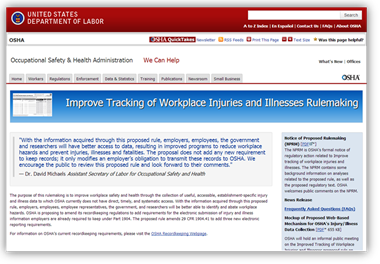
Will OSHA’s Proposal To Publicize More Employer Injury Data Improve Safety?

newrelease_11072013

OSHA has announced a proposed rule which will require establishments with 20 or more employees, in certain industries with high injury and illness rates, to electronically submit their summary of work related injuries and illnesses to OSHA every year.  The change may affect between 450,000 and 1,500,000 sites. Currently, OSHA uses a list of 160,000 employers to require approximately 80,000 employers per year to submit data as part of its OSHA Data Initiative (ODI).  The Department of Labor’s Bureau of Labor Statistics (BLS) approaches approximately 250,000 sites per year as part of its Summary Of Occupational Injuries and Illnesses (SOII).  OSHA uses its data to target certain industries or establishments for inspections and other initiatives.

One can see many ways in which OSHA could use more data for more effective targeting.  The biggest concern seems to be how others would use this data, which OSHA would make accessible to the public.  On first blush, one could argue that there is no downside to sharing individual employers’ injury and illness summaries.  If properly handled, no “identifiable” embarrassing individual employee information would be available.  However, let’s consider the full implications of this proposal, or more adequately, let’s consider how this initiative could be abused.

Regulation By Shame?

OSHA press releases emphasize that the data collection would allow OSHA to better target inspection efforts and would highlight employers with especially strong commitment to safety.  However, since  a November 2010 conference where Dr. Michaels, Assistant Secretary, OSHA,  stated that, “we will continue to practice regulation by shaming,” this Administration has championed such an approach.  These are the same people who have gutted OSHA consultation efforts and shown lackluster interest in OSHA’s showcase cooperative effort, the Voluntary Protection Program (VPP).  It seems unlikely that a significant reason for the initiative is to highlight good employer performance. At least, that’s not how the Administration has worked so far.

Potential for Misuse

One also has to ask the extent to which this expansion is driven at the request of unions and third parties who want access to such data in order to attack specific employers.  As an example, consider the 10-year campaign against Hyatt by the union, UNITE-HERE.  UNITE-HERE created its “Hyatt Hurts” campaign in order to compel Hyatt to recognize the union at non-union facilities or to give in to collective bargaining demands at other sites.  The union focused on injuries associated with housekeepers.  The union was involved in studies which purported to show that the hospitality industry, and Hyatt in particular, required housekeepers to change too many beds per shift, which contributed to ergonomic industries.  (This Job Hurts!) The union was then involved in persuading OSHA to investigate dozens of alleged instances of ergonomic violations throughout the country. Dr. Michaels, actually took the extraordinary step of writing a highly publicized Hazard Alert letter to Hyatt criticizing their practices.  The campaign finally cooled after the union shifted its attention to opposing the nomination of Hyatt principal and former Obama fundraiser, Penny Pritzker for Secretary of Commerce.  Hyatt supposedly changed its position and the nomination moved forward.

How did the union and the research groups obtain Hyatt-specific information which purported to show that Hyatt workers suffered disproportionately from ergonomic injuries?  The data was not available on a government site.  Rather, the union used existing OSHA provisions allowing employees, former employees, and their “representatives” to obtain extensive injury and illness data.  They then fed this data to groups for analysis and arguably for manipulation.

We don’t know how much merit the union’s claims possessed, but the tactics often employed by the union seemed designed to cause the maximum pain possible, and one has difficulty seeing how the campaign benefited Hyatt or its workers.  Hyatt is just one example.  Consider the increase of public attacks on large international retailers for a host of alleged safety hazards.  Again, we’ll not comment on the allegations, but almost all of the attacks are against “non union” employers, which raises questions about their purpose.

On one hand, we can see the value of establishing a better database for OSHA to use in determining where to focus its limited enforcement resources.  However, one must ask whether this arguable increase in efficiency outweighs the potential anti-competitive mischief presented by the easy assets to previously private data.  Will OSHA be further pulled from its core safety enforcement duties?  Some recent OSHA actions raise questions about the reasons for OSHA’s priorities, such as the divisive February 2013 Interpretation in which OSHA changed 40 years of precedent to propose that community organizers, union personnel at companies where they were not the certified bargaining agents, and other third parties could participate in OSHA inspections.  How is OSHA’s mission facilitated by taking action which guarantees intrusions by third parties which will generate conflict and warrants; activities which further eat away at OSHA’s limited resources?

Is OSHA Acting Inconsistently?

Is this data even the proper data on which we should focus?  OSHA has led the charge attacking employer safety plans which measure their success based on this same injury data, claiming that reliance on this data may lead employers to discourage employees from reporting workplace injuries.  Check the OSHA newsroom for releases on retaliation cases pursued by OSHA.  Moreover, employers and OSHA agree that it is ineffectual to target one’s safety efforts on “lagging indicators.”  Instead of focusing on injuries, which are lagging indicators, employers should focus on the “leading indicators,” which are the actions which will prevent injuries.  A major problem is that many customers select suppliers and construction contractors based on various injury statistics, which further create the risk of chilling employee injury reports.  Moreover, such statistics can be affected by other factors.  As my economics prof said, “torture a number enough and it will confess to anything!”

And yet, OSHA’s ODI expansion will focus even more attention on these numbers and distract employers focus from preventive actions.

The public will have 90 days, through Feb. 6, 2014, to submit written comments on the proposed rule. On Jan. 9, 2014, OSHA will hold a public meeting on the proposed rule in Washington, D.C. A Federal Register notice announcing the public meeting will be published shortly.  We suggest that you consider this subject and act accordingly.

We should support efforts which improve worker safety.  The question is whether this proposal would improve worker safety or be used to create distractions from real safety issues.  You decide.

Howard

Posted in hospitality, OSHA, recordkeeping, Washington | Tagged , , , | Leave a comment

Should Employers Conduct Employee Surveys?

I recently read an article stating that over one-half of 250 HR respondents thought that the traditional employee survey is dead.  Most respondents felt that the future of employer research was “qualitative” rather than “quantitative,” and 80% believe that mobile technology will become the most common way for employees to voice their opinions.

A summary of the article in HR Magazine Co. UK observed that, although respondents believe mobile technology would be the most common means of surveying employees in the future, most respondents did not have the social technology to gather such feedback.  As one commentator wryly observed, it was amusing that “a survey has been used to predict the demise of employer surveys. . . .  much of the report is expressed in terms of the percentage of people who agree with this or disagreed with that.”  This commentator went on to note:

This tells us that numbers and words are important as bench marks and as illustrations of how communities think and feel.  The authors have failed to generate an alternative method to surveys in pursuit of the cause they discredit surveys….

As with all things, surveys or otherwise, it’s not what you do, it’s the way you do it.  There are good surveys and bad surveys.  Yes, we should embrace new technologies, as all good providers are, but let’s not pretend that the need for quantitative analysis (and resulting action) is dead.

My Observations

I agree that traditional surveys still have a role in the workplace, and their effectiveness largely depends upon how the survey is employed.  My first observation is that many employers do not use any type of employee survey, and also do not employ any other quantitative or qualitative methods to take the temperature of their employees.

My second point is that a “qualitative” process, such as supervisors interviewing employees or using focus groups or any other method of promoting conversation is superior to a survey. As a labor lawyer, I would obviously prefer that employers regularly conduct qualitative surveys of employees and avoid the problems that may cause union activity. Many employers suddenly seem to “get religion” during a union drive and wish that they had earlier taken steps to learn why employees believed that they need a third-party between them and the employer.

However, the reality is that many employers do not believe that they have the time, and their supervisors do not have the training to effectively seek qualitative input.  Given this workplace reality, a quantitative employee survey may be far better than no effort.

My third observation is that if an employer does not follow-up on survey results, they will make things worse than if they never asked.  When I was a “baby lawyer,” in the early 80’s, I responded to union and other legal problems at a now defunct company where the problems had been triggered by the employer’s failure to act on employee survey results.  When I found the survey results literally gathering dust on top of a filing cabinet, I was horrified to see countless “specific” references to discrimination, unfairness, inability to be promoted, favoritism, and basic failures, such as non-working water fountains and filthy bathrooms.

Using Employee Surveys For  Specific Issues, Such As “Safety Culture”

While the traditional employee survey may be declining in popularity, it’s use is increasing as employers seek to determine their “safety culture” and take actions to improve it.  I encourage managers to conduct discrete surveys of both employers and employees, and then notice the disconnect between responses.  Nowhere is the disconnect more apparent than in the case of safety.  I never met a CEO who did not assure me that safety was the company’s number 1 value, and they meant it.  However, when their employees were polled, or they came under the fine-tooth comb of an OSHA inspection, the executive learned that safety was taken for granted.

For this reason, I encourage employers to survey employees about their company’s safety practices, supervisor attitudes and safety and work practices; i.e., to determine their “culture.”

But the employer may not like the answers to their survey questions. 

Recently, a survey of several thousand skilled construction craft employees revealed that 93% of respondents felt that their company was currently at risk of an injury or death caused by “avoidable workplace attitudes” such as tolerating the incompetent employee or having a “just get it done” or “this is overboard” approach to work and safety.

Half of those same respondents stated that they were actually aware of an injury or death caused by one of these attitudes. 

Even more troubling, despite their concerns, only one-quarter of respondents said that they would speak up and try to correct unsafe conditions.  To put this in simple terms, only one in four employees said that they would tell an unsafe coworker to use fall protection.  Do you think that any of those employers expected responses from highly skilled craft workers?

How would your employees respond if asked some of the following questions?

Agree/Disagree/Strongly Agree/Strongly Disagree

  • We practice at the jobsite what is in our Corporate Safety Policy.
  • I always receive job-specific training.
  • Supervisors hold us to safety rules.
  • Our contractors work safely.
  • Management is serious about safety.
  • We cover safety issues for the job each day.
  • I hold coworkers accountable for safety.
  • Co-workers can help each other to work safely.
  • It is only a matter of time until I am involved in an accident.
  • Sometimes I am not given enough time to get the job done safely.
  • This is a safer place to work than other companies where I have worked.
  • I am encouraged to report unsafe conditions/near misses.
  • Management turns a blind eye to safety issues at times.
  • Some safety rules and procedures are not really practical.
  • Safety is one of the first things upper management talks about.
  • Upper management seldom comes on the floor.
  • Upper management is involved in safety training.
  • Upper management is involved in new employee orientation.

No survey obviates the need for front-line supervisor to remain alert and to talk to their employees.  Survey results will be meaningless if no one in top leadership champions the process.  Employers, like children, do not much care about our words; they observe our actions.

Don’t get me wrong.  I am excited about the new technologies and methods described in the survey.  There is a great deal of information to mine.  However, I would be pleased to see any additional efforts to learn what employees really think.

Howard

Posted in attitude/culture, cultural changes, employee engagement, employer policies, management and leadership, safety programs, safety technology and apps | Tagged , , , | Leave a comment

Are Meetings the Bane of Your Existence?

I had not previously read posts by Ron Thomas, but based upon his recent TLNT post, The Problems With Meetings?  They Cost More Than They’re Really Worth, Mr. Thomas is that rarest of leaders . . .:  an individual with common sense and great judgment.  I relate to Thomas’ comment:

Meetings are the bane of corporate existence.  Whether it is a conference call or a physical meeting, these are part of our process of doing business, and for the most part they are not going away.

Just Say No!

Thomas goes on to conclude:

Let’s face it – Most meetings are a drain and a waste of time.  How many times have we sat there and realized that the meeting had turned into something else, and the discussion is like talking to an aged uncle where it starts in one direction and ends someplace else.

Mr. Thomas then cements his status as a management “stud” by not  offering the proverbial “7 steps to improve meetings.”  Instead, Thomas cuts to the chase:

My magic bullet is to not have them in meetings in the first place.  In 7 months in my new role, I have called two all-hands-on-deck meetings.  I had one to introduce myself, and one more to discuss how we would move ahead with our processes.  I will probably have one more before the end of the year to lay out my HR plan and walk them all through it.

While Thomas wisely refuses to offer a formulaic “7 step plan” to recover from meeting addiction, he does share a number of useful ideas.  Thomas first states that he consciously reminds himself that “our days are precious and we all know that when we arrive at work, we have our list of things to do to accomplish that day.”  In other words, as the big dog who often schedules meetings, he weighs the value of a meeting before automatically hitting his outlook scheduler.  He then acknowledges that when a meeting is called, “there is trouble ahead if the concept is not clear.”  He uses conversation, email, or better yet, a face-to-face discussion to narrow and frame the topics.  He also champions educating other people to understand that meetings may be more of a time waster than even internet use:

What has always amazed me was how initially, companies would lock down the internet and/or block social sites because they considered them time wasters.  However, pull out the time clock and measure the amount of money that is sitting around the conference room during an overlong meeting and the true time waster will pop up.

Ron succumbs to the need to offer a few bullet points at the end, but his recommendations are practical:

1.   If you are the meeting chairperson, don’t be weak because you are the conductor.  If it is bad it is because of YOU.

2.   Have a clear agenda.  “What, pray tell, are you trying to solve?

3.   At the end of the meeting, what decisions should be made?

4.   Think – how much time do you really need to arrive at a decision?

5.   Always! – think about that meter that is running in the background.

Practical Guidance On Meetings

Perhaps we do need a 7 Step Program to address our addiction to meetings.  The Harvard Business Review Blog Network regularly posts relevant articles, including the appropriately titled, Break Your Addiction To Meetings” by Elizabeth Grace Saunders.  Ms. Saunders starts out her blog as follows:


Manager, Noun

Textbook Definition:  An individual whose in charge of a certain group of tasks, or a certain subset of a company.  A manager often has a staff of people who report to him or her.

Modern Translation:  An individual who races through the halls in a frantic attempt to make the next meeting on time while also answering emails on his or her mobile device.

Ms. Saunders immediately moves to recommendations.  Her most basic recommendation . . .

“reduce the number of meeting invitations that you accept.” 

She proposes that one always asks whether they really need to attend the meeting, and either decline or use one of the following strategies:

  • Ask for a pre-meeting look at the agenda so you can pass on your comments to the facilitator to share.  (Bonus:  this may force the facilitator to actually make an agenda!)
  • Send someone else from your group to communicate your team’s position.
  • Request a copy of the meeting notes after the fact.

Now, Ms. Saunders goes to the jugular.  “Reduce the number of meetings you schedule – and reduce their length.”  Ms. Saunders asked, “do you schedule meetings where you spend most of the time talking – perhaps giving ‘updates’ to a room of people subtly checking their phones?  Do you default the scheduling-hour long meetings (or longer)?”  If so, you need to reprogram your default response of “when in doubt, schedule a 60 minute meeting.”

Ms. Saunders raises the much neglected issue of meeting “etiquette:”


  • Don’t schedule for FYI when you can communicate by email.  Only use meetings for discussions and decisions that must happen with a team, in real-time.
  • Send a clear agenda when you send the meeting invitation – not two minutes before the meeting – so it’s easier for everyone to tell whether they need to attend.
  • Designate someone to take thorough notes on the discussion, the decisions, and the rationale behind these conclusions.  Circulate those to your manager, and anyone else who might need to be in the loop – but doesn’t need to come to the meeting.

I strongly agree with Ms. Saunders’ final admonition, which is to “keep your calendar clear by blocking in work time.”  Ms. Saunders observes that if one refrains from meetings, they might accomplish more “actual work.”  It might not surprise one to learn that Ms. Sanders describes herself as a “time coach,” and earlier this year posted, “Stop Work Overload By Setting These Boundaries.”

If the answer is “just say no,” why does everyone agree that we seem to be making little progress in reducing the number of meetings?

I sometimes wonder if we are overly fixated on achieving “consensus” either out of a sense of fairness or a desire to avoid political attacks.  Sometimes, I find myself simply wishing that someone would make a decision or delegate responsibility.  Of course, an autocratic decision-making system excludes other worthwhile ideas.  In a 1996 article, “Fast Company” described the importance of meetings and the effect of “bad meetings.”

Meetings matter because that’s where an organization’s culture perpetuates itself. . . .  Meetings are how an organization says, “you are a member” so if everyday we go to Board meetings full of boring people, than we can’t help but think that this is a boring company.  Boring at meetings is worse than negative messages about a company and ourselves.” 

Back To The Future Advice On Meetings

The author, Eric Matson, goes on to list his “7 Deadly Sins of Meetings:”

Sin No. 1:  People don’t take meeting seriously.  They arrive late, leave early, and spend most of their time doodling.  (Keep in mind that this article was written in 1996 before the advent of apps).

Salvation:  Adopt Intel’s mindset that meetings are real work.

Sin No. 2:  Meetings are too long.

Salvation:  Time is money.  Track the cost of your meetings and use computer-enable similarity to make them more productive.

Sin No. 3:  People wander off topic.  The participants spend more time digressing than discussing.

Salvation:  Get serious about agendas and store distractions in a “parking lot.”  (I wonder if this 1996 article created that sometimes overused concept of the “parking lot.”)

Sin No 4:  Nothing happens once the meeting ends.  People don’t convert decisions into action.

Salvation:  Convert from meeting to “doing” and focus on common documents.

Sin No. 5:  People don’t tell the truth.  There is plenty of conversation but not candor.

Salvation:  Embrace anonymity.

Sin No. 6:  Meetings are always missing important information, so they postpone critical decisions.

Salvation:  Get data, not just furniture, into meeting rooms.

Sin No. 7:  Meetings never get better.  People make the same mistakes.

Salvation:  Practice makes perfect.  Monitor what works and what doesn’t and hold people accountable.

After reading this useful, albeit aged article, my conclusion remains that we should wage a holy war to reduce the number of meetings.  As the “De Motivators” poster for “Meetings” states . . . “none of us is as dumb as all of us . . . .”


Howard

Posted in attitude/culture, cultural changes, employee engagement, generational differences, management and leadership | Tagged , , , , | Leave a comment

« Are Your Employees at Risk of Isocyanate Exposure?

From my friend, Brian Edwards, whom I have found to have great wisdom when dealing with combustible dust challenges.

« Are your employees at risk of isocyanate exposure? | Main

Conversion Technology engineers to wear FRC when conducting Combustible Dust Hazard Analysis

Flame resistant clothing (FRC) has been used for years in a number of industries to protect workers from flash fires, arc flash, embers, molten metal, and other potential sources of ignition to clothing.  The reason FRC is so important is that many fatalities have occurred because a worker’s clothing has caught on fire, exposing him/her to burning heat for a much longer time than would have occurred during the initial event (e.g. arc flash, vapor flash fire).

When looking at burn victims, there is a “magic” number – well, more accurately, a statistically relevant number – that predicts if the victim has a better chance of surviving … or dying.  This number is 50%.  Meaning, when the percent of a person’s body with 2nd or 3rd degree burns exceeds 50%, it is more likely that he will not survive.  FRC is extremely valuable in minimizing the percentage of 2nd/3rd degree burns for a person exposed to a flash fire or other short duration thermal exposure (less than 3-4 seconds). It does this not by providing insulation, rather, FRC resists catching on fire and becoming a source of burns itself.

As I mentioned earlier, a number of industries have adopted FRC as standard issue clothing – think petroleum refining and steel mills. One area where the need for FRC has become more apparent is for workers potentially exposed to combustible dust flash fires. When combustible dust is suspended in air in sufficient concentrations, and there is a source of ignition, a flash fire very similar to that of a vapor fire can occur. Workers in the vicinity can be exposed to both the initial event, but they also stand the risk of having their clothing ignite.  Because of this, NFPA 654 – Standard for the Prevention of Fire and Dust Explosions from the Manufacturing, Processing, and Handling of Combustible Particulate Solids – now details the need for considering FRC as part of the hazard analysis conducted for an industrial plant where combustible dust is present.

At Conversion Technology, Inc. (CTI), our safety and environmental engineers have long wore FRC when it was required by our client’s facility. However, we have noticed that a large percentage of industrial facilities with potential combustible dust hazards have not considered FRC in their Personal Protective Equipment (PPE) hazard assessment. Therefore, we have decided that regardless of the Client’s requirements, we will require all engineers conducting combustible dust hazard assessments to wear FRC while on site.

Not all facilities who process and handle combustible dust will need to require FRC.  Part of CTI’s scope of work while conducting a combustible dust hazard assessment is to determine whether or not FRC is needed. However, until we have made that determination, our engineers will not know if they will be walking into an area where they are potential exposed to a dust fire hazard.  This unknown is why we have made this decision.

We hope that all facilities that handle and process combustible dust will make the effort to determine if workers are potential exposed to combustible dust fire and explosion hazards. Conversion Technology is available to help those that need assistance in making this determination.

Posted in combustible dust, maintnance and engineering, MOC, PPE | Tagged | Leave a comment

Safety Has Missed the Boat On Sustainability

I have been sharing materials from the EHS Today “America’s Safest Companies” conference which we co-sponsored the last week.  I experienced one of those epiphany experiences while listening to Dr John Howard and representatives of GE and Georgia Pacific explain that surprisingly, safety professionals have been left out of corporate efforts to champion sustainability.  We have left the environmental folks to lead the way, and that makes no sense.  It is sensible that the safety professionals work hand-in-hand with the environmental proponents in making the myriad of small to large decisions to improve corporate sustainability.  Please read EHS Today’s report ….

ASC 2013: Safety ‘Missed the Boat’ on the Corporate Sustainability Movement

Thu, 2013-10-31 18:31
To become a more intrinsic part of a company’s sustainability efforts, the EHS profession needs to change the way it defines and measures safety success.
image/gif iconDusty Ferrell, vice president of global safety and health for Georgia Pacific, on the future of the safety profession: “I hope it’s people like you who don’t look at your work life as a job or a career but as a ministry. And your ministry is helping create and sustain a better quality of life for anybody you have the ability to influence.”
Promo Image (large)

It’s become standard practice for Fortune 500 companies to set big sustainability goals, measure their environmental performance and trumpet the results in their annual reports. But three decades after sustainability emerged as a mainstream issue for corporate America, workplace safety and health still resides in the shadows, by comparison.

“We missed the boat,” NIOSH Director John Howard said during a panel discussion at the 2013 America’s Safest Companies Conference in Atlanta. “We’re 30 years behind the sustainability movement. We have to catch up, and we have to catch up fast.”

For safety to receive equal billing with sustainability, the profession needs to change the way that it measures and communicates its value, the panelists asserted.

“You go into an operations meeting, and you have finance, quality and production all standing there talking. As soon as EHS walks in the room, it goes quiet,” said Michael Vigezzi, General Electric Co.’s global manager for VPP and safety programs. “Why? Do we have the acumen to come to the table [with other departments], or are we just the fire extinguisher people?”

Part of the problem is that EHS professionals – whether out of habit or necessity – traditionally have focused their energy on compliance with policies, procedures and regulatory standards, Vigezzi said.

“When we hire safety people, it’s very hard to find someone who can go into a facility with 2,000 people, understand the gaps to get us to excellence there and show me a three- to five-year plan on how we’re going to close those gaps,” said Dusty Ferrell, vice president of global safety and health for Georgia Pacific. “Because they’re always in firefighting mode.”

For EHS professionals to earn a more prominent spot at the table, “we need to realize that we have to focus on partnerships, not just compliance,” Vigezzi added.

“At GE, we’ve been looking more for generalists rather than specialists,” Vigezzi explained.

“We need them to understand engineering. We need them to understand operations. They have to be able to work in partnership so we’re no longer a tollgate.”

Focus on Leading Indicators

As the EHS profession tries to make safety a more intrinsic part of sustainability efforts and overall business operations, the panelists agreed that there needs to be a much greater emphasis on leading indicators.

“We’re 30 years behind, but we have a lot of information and we’re doing a lot of great things,” GE’s Vigezzi said.

“We just need to come to the table and be able to talk about it, and that’s our biggest gap – we don’t know how to communicate what we do in safety other than talking about injury and illness rates and lost-time rates.”

GE, Georgia Pacific and a growing number of firms are measuring their safety success with leading indicators such as training hours, audit participation, near misses and preventive maintenance, in addition to traditional injury and illness data.

“There are a lot of indicators that tell you the healthiness of your EHS process” [other than lost-time injury rates], Vigezzi said. “Pull them into the forefront. It’ll take some time. We’re still struggling through it, but we’re getting better at it.”

Sustainability of the Workforce

The panelists also suggested that the safety profession can level the playing field with the environmental movement by redefining itself as a steward of workforce sustainability.

Georgia Pacific, for example, defines safety excellence as creating and maintaining a high quality of life for its associates – before and after they retire.

“If someone spent his life working for us, what I mean by quality of life is, can I bend over and pick up my granddaughter tonight?” Ferrell said. “Or do I have to say, ‘No baby, I can’t pick you up, I have to wear a back brace because I worked for this company.'”

Howard noted that NIOSH is working with the U.S. Green Building Council to incorporate occupational safety and health indicators into its popular LEED certification program.

“That way a company can be viewed not only by the nice skylights that it has in its building but also by how that company treated” workers during the construction of the building, Howard said. “There’s a whole scope of sustainability that we have in front of us.”

READ MORE ARTICLES FROM THE CONFERENCE AT EHS TODAY … AND DON’T MISS NEXT YEAR’S EFFORT.

Posted in maintnance and engineering, management and leadership, safety programs, training | Tagged | Leave a comment

Great Safety Info from “Plant Engineering”

I enjoy articles THAT I discover in Plant Engineering because one of my (many) goals is to obtain more coordination between the safety, engineering, maintenance and purchasing functions.  Management of Change (MOC) affects far more than PSM, combustible dust and guarding and interlocks.  We should all try to understand the plant engineers approach and work to better integrate safety and sustainability into those decisions.  The following article is one of several on Plant Engineering’s site.

Study finds safety is a path to productivity

Results of a recent study showed that companies reporting the lowest injury rates also had the best productivity

Mark Eitzman, Rockwell Automation
10/18/2013

Good safety is good business. However, this has not always been the case, with many manufacturers generally believing that each investment made in safety had a negative impact on efficiency and productivity.

Today, this view has changed with many top performing manufacturers proving that with contemporary safety automation technology, protection of workers on the plant floor can boost productivity, and the bottom line.

Results of a study conducted by the Aberdeen Group and sponsored by Rockwell Automation showed that companies reporting the lowest injury rates also had the best productivity. The study found that safety, promoted from the top by senior management, was as an essential element of the workplace culture. The report also showed that best-in-class manufacturers rely on advanced safety technologies and carefully calculated procedures to help maintain high levels of workplace protection. (CONTINUE READING)

Also, please read the following article on the same site:

5 things to consider when selecting a safety system

Performance requirements now drive the selection process

Luis Duran, ABB
10/29/2013

Safety is among the top priorities in any manufacturing facility, and given the changes in the industry, technology and even standard, there are a lot of concerns starting with the selection of a safety system.

The performance based safety standards (IEC61508 and IEC61511/ISA84) have changed the way safety system selection should happen. Gone are the days of simply choosing a certified product, or selecting a preferred architecture; today’s system selection is driven by performance requirements.

1: Hazard understanding

Correct, this has nothing to do with the safety system hardware. It is critical in the process to understand the scope of the process hazards and to determine the necessary risk reduction required. This should be done to create the Safety Requirements Specification (SRS) necessary to start a system selection. Even when replacing an existing system, this is critical as the risk profile of the plant may have changed since installation. 

2: The more diverse the better

Technology diversity: There has been a long standing requirement that a safety system must be different (or diverse) technology from its process automation counterpart to avoid common cause failures. But most safety systems rely on component redundancy (hardware fault tolerance, or HFT) to meet reliability and availability requirements, introducing a degree of common cause failure directly into the safety system.

Rather than redundancy, leading systems now provide diversity of technologies designed into logic solvers and I/O modules, along with a high degree of diagnostics, to allow a simplex hardware configuration to meet SIL3 requirements.

Product implementation diversity: The standards are imposing diversity on the way manufacturers deliver the product you buy. Even though most safety systems are manufactured by process automation vendors, organizational diversity between the two product teams is only the first level of separation.

Within the safety product team, leading suppliers will also be separating the design group from product development group and then again from product testing group. Ask your potential suppliers how diverse they really are?  (CONTINUE READING)

Howard

Posted in combustible dust, food processing, hazard assessment, maintnance and engineering, MOC, safety programs, safety technology and apps, sustainability | Tagged , , , , , , | Leave a comment

Smooth Restart For OSHA So Far.

Whatever you may think of this Administration, one has to admire how well OSHA returned to full operations after the government shut down, and the behind the scenes work that made the return seem so seamless.  As I wrote earlier and as reported by BNA, EHS and others, a small cadre of OSHA Area and Regional Office personnel did far more than simply respond to fatalities during the shut down.  As a result, immediately upon return, OSHA Area Office personnel started dialing employers and advising them that they would treat the shutdown days as Federal holidays and extend the contest period for those cases contested if the parties wanted an Informal Conference.  Since the return, we have participated in Informal conferences in Georgia, Florida, Illinois, New Hampshire and elsewhere.  I was pleased that in each case, the Area Office was well prepared.  Few things more frustrate me than when I extol the virtues of an Informal Conference and then it is obvious that the Office did not even read the file before we arrived, which is a waste of everyone’s time.  Not once since the return to work have we had this experience.  We’ll probably try a couple of the cases on which we have met, but not for lack of a spirited and detailed exchange at the Informal.  Talk to your counsel, but in most cases, you should take the opportunity for the belated Informal Conference.

The Solicitors attorneys seem more slammed because basically none of them  were allowed to work during the shut down, and no cadre continued their case prep in their absence.  The OSHRC Judges seem to be doing pretty well.  Many of these judges have excellent staff and they are accustomed to wheeling and dealing to make schedules work.

Finally, our thanks to EHS Today and especially to BNA for providing useful information to interested parties during the shut down.  I cannot overstate my high regard for both publishers, and the timeliness of their information.  Their efforts prevented more confusion than occurred.  We have pasted below some excerpts from BNA’s last article yesterday which includes comments by my friend Eric Hobbs and by me.

By Stephen Lee and Bruce Rolfsen

With the 16-day shutdown of the federal government over, the Occupational Safety and Health Administration came back to life Oct. 17, restarting its enforcement, standard-setting and other activities.

Office of Management and Budget Director Sylvia Mathews Burwell instructed furloughed federal employees Oct. 17 to reopen their offices in a prompt and orderly manner, upon President Barack Obama’s signing of a continuing resolution that restored funding to the government.

OSHA’s staffing level during the shutdown fell from 2,235 to 230, according to a Sept. 25 contingency plan from Solicitor of Labor Patricia Smith.

Shutdown Veterans Recall Smooth Return

The agency didn’t respond to an interview request, but veterans of the last government shutdown in 1995 recalled that the return to work was largely uneventful.

“Everybody shows up to work, there’s a lot of talk about the shutdown, and people are happy to see each other, so there’s just that type of camaraderie,” said Celeste Monforton, an OSHA policy analyst when the 1995 shutdown began, in an Oct. 18 interview with Bloomberg BNA.

During the 21-day shutdown, Monforton, now a lecturer at George Washington University, took a job at the assistant secretary’s office of the Mine Safety and Health Administration.

Adam Finkel, who served as the head of OSHA’s health standards division during the 1995 stoppage, said his group recovered quickly, easily resuming work on long-term projects such as rulemakings on methylene chloride and powered industrial trucks and revisions to the respiratory protection, confined space and grain handling standards.

OSHA May Be Strained

“Like anything else, there’s diversity in the staff, so there were people who hit the ground running right away and there were people who took longer to get back in gear,” said Finkel, now the executive director of the Penn Program on Regulation at the University of Pennsylvania.

Monforton recalled that some MSHA managers handled the extra paperwork that had built up during the shutdown by temporarily moving some staffers from one task to another.

OSHA might find itself particularly strained in the near term, Monforton said.

“They don’t have a lot of extra people. They already are working at maximum capacity, so there’s no flex in there. You’re expecting a lot from individuals.”

Employer Attorney Perspective

Howard Mavity, an attorney and co-chairman of Fisher & Phillips LLP’s workplace safety practice group, told Bloomberg BNA Oct. 22 that from his perspective OSHA’s enforcement activities were quickly back in place following the end of the shutdown.

“In the first hour they were back, I scheduled three informal conferences,” Mavity said about on Oct. 17. “Two whistle-blower investigators called me by noon.”

From his own experience and what he has heard from attorneys at the firm, Mavity said OSHA area offices are going ahead with informal conferences to discuss recently issued citations in cases where the 15-day response time expired during the shutdown.

The OSHA solicitor’s office and the Occupational Safety and Health Review Commission seem to be taking longer to return to a normal schedule because the furlough of Labor Department attorneys and review commission administrative law judges meant case preparations stopped and hearings were canceled, Mavity said.

While the commission and administrative law judges are trying stay on schedule, Mavity said, they’ll have to decide if hearings and trials set for the immediate future should be delayed because government attorneys could not work for 16 days.

Eric Hobbs, an attorney with Michael Best & Friedrich LLP in Milwaukee, said that during the shutdown OSHA field offices with cases he is handling stayed in contact with him. In one case involving a fatality, OSHA held a closing conference during the shutdown and then issued the citation the same day.

Now that the shutdown is over, the OSHA offices he deals with are taking calls on all matters, Hobbs said.

Associations Praise Private Sector

Dave Heidorn, manager of government affairs and policy at the American Society of Safety Engineers, said it would be helpful, though extremely difficult, for OSHA, the National Institute for Occupational Safety and Health and state plans to assess the impact of the shutdown on workplace safety and health.

“There’s far too little information on the effectiveness of enforcement or voluntary programs,” Heidorn said. “A period when nothing happened may be a small opportunity to get a glimpse of the impact. It’s a big-picture issue all of occupational safety and health would benefit from knowing more about.”

Similarly, Barbara Dawson, president of the American Industrial Hygiene Association, said in an Oct. 17 statement that it would be difficult to assess the impact the shutdown has had on worker safety and health.

The group also applauded the efforts of the private sector, industrial hygienists and safety officers who stepped forward during the shutdown to ensure worker safety.   ….

(Please continue reading at BNA.)

To contact the BNA reporters on their story: Stephen Lee at stephenlee@bna.com and Bruce Rolfsen at brolfsen@bna.com in Washington

In the longer run, we will see repercussions of the shut down and especially within the already underfunded consultation efforts.  The most positive fact to come out of the shut down is that in the absence of normal OSHA enforcement, the vast majority of employers did not lessen their safety efforts, and many employers consciously stepped up their efforts, such as in monitoring contractor efforts.

Howard

 

Posted in government inspections, OSHA, state osha plans, Washington | Tagged , , | Leave a comment