Have you Prepared For Third Party Embarassment Tactics?

The areas of labor, employment, and safety exposure which present very real threats to the distribution industry. There are several reasons for this increased focus on these types of business:

■Distribution is a huge market for plaintiff lawyers who want business, unions who need members, and government agencies seeking to be relevant in the new workplace.
■The Administration and third party groups such as “Occupy Wall Street” spin offs, are critical of the often non-union supply chain process. The Wage Hour Director wrote a scathing book titled, The Fissured Workplace: Why Work Became Back So Bad For So Many And What Can Be Done To Improve It. The book raises valid concerns, but you won’t like the proposed “fixes” of more regulation and encouragement of unionization.
■You may also suffer ancillary damage resulting from attacks on your customers. Third parties may attack suppliers and distributors as a way of bringing pressure on the customer. Or unions may try to embarrass a distributor’s customers in order to force the distributor to “voluntarily”recognize a union.

Embarrassment & Public Attacks Are the New Organizing Tool

Unions and other third parties have never before so heavily used public embarrassment as a means of organizing employees. The key to union organizing is to find a disgruntled employee who will serve as a leader and capitalize on existing workplace problems. These problems are typically compounded by communications breakdowns and ineffective supervisors. Surveys show that the most divisive workplace issues are a sense of unfairness, discrimination, an unsafe workplace, and a sense that the employer does not care about employees.

PLEASE CONTINUE READING AT INDUSTRIAL DISTRIBUTION.COM

Posted in auto industry, boycotts, class actions/systemic investigation, hospitality, manufacturing, public attacks, restaurants, retail, unions | Leave a comment

The “Root Cause” Of Most Workplace Problems Is A Lack Of “Good Judgment”

I no longer use the term “common sense” other than to criticize the term as having lost its meaning.  The majority of the 500 or so workplace death cases I have investigated have involved poor judgment by an otherwise decent and skilled worker.  Many incidents of alleged harassment and discrimination may not meet the legal standard of unlawful behavior but demonstrated remarkably bad decision making.  There is an absence out in the work world of this so-called “common sense.”

Commonsense demands that the term be renamed “uncommon” sense.  The “common” aspect of common sense is supposed to be “knowledge, judgment, and taste, which is more or less universal and which is held more or less without reflection or argument.”  The “common” behaviors described above do not match Miriam Webster’s definition of “common sense”as “the ability to think and behave in a reasonable way and to make good decisions.”  Nor do these worker behaviors satisfy Karl Albrecht’s definition of “Practical Intelligence” which is the “mental ability to cope with the challenges and opportunities of life.” 

I do not know if there was a time when more people practiced common sense, but certainly I do not live in that period.  I prefer to use the term “good judgment,” which is hardly “common.”  Rather than define “good” judgment, let’s look at the McMillan Dictionary discussion of “bad” judgment:


Foolish –                      lacking good sense and judgment;

Impulsive –                  tends to do things without thinking about what will happen as a result;

Unthinking –                done without thinking that it might be wrong or stupid;

Impetuous –                 does things quickly without thinking about what will happen as a result;

Ill-considered –            made or done without careful thought;

Undiscriminating –       deciding what one likes without carefully thinking about the value of qualities of different choices;

Hasty –                        doing things in a hurry, without careful planning or thought;

Automatically –            without conscious thought or intention, especially because of habits; and

Shallow –                     not interested in serious ideas, strong feelings for other important things.


Teach people how to avoid bad “judgment” and you’ll eliminate most workplace problems.

Fortunately, you can train most workers to practice good judgment.  As an example, the essence of using good judgment in working safely is to constantly pause before the next task, think about the hazards and how to perform the job, and take the necessary steps to finish the job without incident.  Similarly, many claims of harassment and discrimination would be avoided if a supervisor simply paused to think about how their remarks would appear, or to ponder whether they really should say that in an email.  I will continue to write about the role of good judgment in the workplace, but as a starting point, I encourage you to dig more deeply in your root cause analysis as to why employees do the wrong things.  The “J” word may pop up.  Then perhaps you can regularly conduct “tool box”-type talks to remind employees to use that uncommon good judgment.

Posted in Uncategorized | Leave a comment

Familiar But Great Reminders Of Bad Facebook Judgment

11 Brutal Reminders That You Can and Will Get Fired for What You Post on Facebook// // // <![CDATA[
document.write('.js-display-none { display: none !important; }’);

// ]]>//

11 Brutal Reminders That You Can and Will Get Fired for What You Post on Facebook

11 Brutal Reminders That You Can and Will Get Fired for What You Post on Facebook

In this new society that we’ve all agreed to be a part of, your Facebook page is an extension of yourself. For this reason, it’s not a good idea to post anything there that you wouldn’t normally say, for example, to your boss.

The unfortunate folks below didn’t get that memo. Here are 11 examples of Facebookers who weren’t so careful with what they shared and, as a result, put their employment statuses in jeopardy because of it.

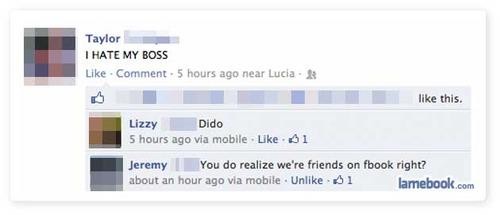
1. Broadcasting to your online friends how much you hate your boss is probably not going to help you stay employed, especially if your boss is one of those online friends. This embarrassing post (below) probably did a number on our poster’s relationship with said boss.

image

Anonymous employee in hot water. (lamebook.com)

2. A Swiss woman in 2009 was playing what would normally have been a simple case of hooky, claiming that she had a migraine and could not work in front of a computer screen. Unfortunately, her employer noticed that she had signed in to Facebook that same day. Saying that this had “destroyed its trust in her,” company management decided to let her go. In defense, the woman did claim to have been accessing Facebook from her iPhone, but she was fired (or sacked, as they say abroad), regardless.

image

We’re betting this old story still gives her a headache. (guardianlv.com)

CONTINUE READING AT YAHOO TECH


NOTE: Check with your counsel before disciplining or taking other adverse action against employees who post critical material about the company.  The NLRB has taken a very broad view of what posts constitute protected concerted activity.


Posted in attitude/culture, cultural changes, generational differences, social media | Tagged , , | Leave a comment

My Mother’s Day Tribute

Mother’s Day Guest Post

familyAs a compulsive writer and blogger, it was inevitable that I would write a post acknowledging moms today. I am deeply thankful for my mother and for my wife, and for all that they have had to put up with from me and from life. I doubt that this long missive is one of my better posts, but that’s not the point. I wrote this piece for mom and Karla.  (CONTINUE READING AT KARLA’S CORNER)

Posted in Uncategorized | Tagged , | Leave a comment

Union Calls For May 15 Fast Food Workers Strike In 26 Countries

Fast food workers are difficult targets for union organizing efforts, but it’s simply too large a market for unions to ignore.  Moreover, the fast food industry is an easy target for demands for a “living wage” and attacks on the use of temporary or part-time employees. (expect to see these themes more and more as elections approach).  Beginning in 2012, we saw protests in as many as 100 cities.   The protests, combined with other efforts, have resulted in a great deal of press for the “living wage advocates” and even resulted in National, State, and local laws raising the minimum wage.

Now the International Union of Food, Agricultural, Hotel, Restaurant, Catering, Tobacco and Allied Workers Association (IUF) has called for fast food worker strikes in as many as 150 U.S. cities and protests 25 countries next week on May 15 seeking “$15 an hour.”

Although the IUF and other unions are using the “living wage” demand as a vehicle, the union’s goal is to sign up members and organize restaurants.

I do not know how many workers will heed the call to “strike” on May 15.  Some of the previous protest efforts did not meaningfully affect customers.  Various papers reported “strike votes” in Chicago and elsewhere.

Regardless of whether May 15th radically disrupts fast food restaurant operations, employers should expect these tactics to increase in frequency and aggressiveness.  Unions are using embarrassing public pressure to try to force fast food employers to recognize the union as the employee’s bargaining agent without going to an election.  Unions may fear that they will lose elections because in a campaign, the employer has a chance to share their side of the story.  Of course, unions also claim that employers retaliate against employees and unlawfully discourage the formation of a union.  Therefore, the union approach is to make life so miserable for these employers that they throw in the towel and accept the union’s claim to represent employees without going to election.

Do not judge the effectiveness of these tactics by past fast food protests in 2012 and 2013.  While we doubt that employers will knuckle under to union representation demands simply because the unions hurt the restaurant’s brand, the union efforts may in fact harm the restaurant’s brand and create problems, especially if the employer is not prepared.

Fast food restaurants are tightly staffed and cannot afford many absences.  Similarly, the typical fast food restaurant does not have a large number of managers, and those managers may be completely unprepared for responding to union harassment.  Unions may hope that these employers respond in a knee jerk fashion and “fire” employees who “strike” because this would be unlawful.  This means that restaurants must be prepared to handle employees who engage in protected concerted activity and also must have staffing plans in place to respond to stores which experience meaningful no-shows.

Similarly, the National Labor Relations Act and other laws allow ugly and often untrue communications in labor disputes.  Restaurants must be prepared to respond to hand billing and public attacks on their brand.  Sometimes the best response may be no response.  However, there will be occasions for well prepared PR teams to effectively respond to claims, including by even offering promotional discounts and gift cards to customers disrupted by union efforts.

Also, union hand billing can cross the line and violate property rights, block suppliers or result in an unlawful secondary boycott.  On the other hand, protesters have certain rights on public right-a-ways.  In some jurisdictions, such as California, protesters, including labor protectors, enjoy certain rights to hand bill on restaurant property, including around drive-throughs and at the restaurant doors.  Fast food restaurants need to know their property rights and be prepared to enforce them as needed.

Restaurant brands and their larger franchisees will need to prepare “response teams,” including skilled managers to help affected restaurants, PR personnel, and security and legal advisers.

The union, UNITE-HERE’s efforts against the Hyatt chain show that unions and their affiliate organizations will also bring wage hour, “wage theft,” race and national origin discrimination claims, and many other individual and class action suits and complaints in a further effort to bring pressure on brands.  UNITE-HERE caused the Hyatt group problems by filing nationwide OSHA claims alleging ergonomic violations involving housekeepers, and pointed out that such alleged safety issues disproportionately affected minorities.  Unions are increasingly using safety complaints to put pressure on or embarrass employers or to drive a wedge between employees and management.  While the typical fast food restaurant may not present many of the serious hazards present in foundries and construction sites, there are many routine items which may be missed by under trained and harried store managers.  The unions know about this vulnerability.

An especially despicable tactic is for unions and their affiliated groups to pull hundreds of Health Department Inspection Reports on State and National chains.  The union then finds any reference to cockroaches, rodents or any other disturbing finding, and then may use this information to attack the entire chain or individual restaurants who have experienced glowing health inspection reports.

Some chains, such as Dairy Queen, have already articulately commented on the “living wage” issue, or as in the case of Subway, denounced improper pay practices.  Others have sought to explain the dynamics of the business.

May 15 may not create the disruption hoped for by the IUF, but this “strike” should serve as a reminder to fast food restaurants to be prepared.

(I’ll be running more material on the Fisher & Phillips LLP site).



Posted in concerted protected activity, hospitality, NLRB, OSHA, restaurants, retail, union organizing | Tagged , , , , | Leave a comment

Environmental Leg of Corporate Sustainability

L6SBC's avatarL6S Business Consulting Inc

After getting an idea about Key Performance Indicators, we can move onto learning more about corporate sustainability. A great place to start is where most people know sustainability, the environment.

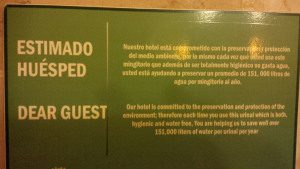
Environmental  sustainability statement. Environmental sustainability statement.

I recently went on vacation at a resort in Mexico where environmental sustainability very pronounced. It is their brand identity.

As the statement to the left shows, they had the common bathrooms outfitted with toilets that didn’t require water. The resort calculated that it would save them 115,000 gallons of water per year. That sort of saving would drop to the bottom line.

Where the resort was built, it was originally a jungle. Much of the vegetation and wild animals are native to the area. Since it is a natural setting, the grounds maintenance upkeep would be minimal in comparison to converting common areas into grass areas, like a North American park.

Why is this all important?…

View original post 292 more words

Posted in Uncategorized | Leave a comment

Warehouse Safety – “The Dangers of Modern Warehouses & How to Prevent Them”

A solid treatment of many of the most common safety challenges in warehousing, distribution and logistics. Good detail.

Jack Benton's avatarEHS Safety News America Blog 🇺🇸

The modern warehouse can be a dangerous work environment. There are fatalities along with general injuries from workplace accidents in warehouses related to forklifts, docks and conveyors. With over seven thousand operational warehouses employing more than 145,000 workers warehouse safety videos and plans for prevention can help businesses save costs on Workers Compensation claims and more importantly save lives and offer safer working conditions in warehouses.

Common injuries from slips and falls, ergonomic related dangers and forklifts, companies who provide forklift training as well as materials handling safety can see decreased numbers of accidents and worker related accidents. Forklifts alone pose the biggest danger and number of deaths and injuries.

What we can learn from the infographic can help in preventing warehouse fatalities and injuries.

• Posting and alerting workers to the tips for safe forklift procedures and requiring specific measures of safety should be posted.
• Proper inspection and…

View original post 127 more words

Posted in Uncategorized | Leave a comment

Is Your Code of Conduct Unlawful? Ask the NLRB

theemplawyerologist's avatarThe EmpLAWyerologist

Suppose you have been struggling with low morale and lack of cooperation among your employees, low client satisfaction, and high employee turnover. Your company culture needs an instantaneous makeover, and you are not sure if even that is fast enough. What do you do? Using the policies of similar companies as your model, you set up employee teams to address some of the more troublesome issues. You decide that your first goal is to develop a Statement of Values and Standards. The employee team charged with this task comes up with a draft and then distributes it to all employees for review and comment. After two more rounds of drafts, the team finalizes its Statement of Values and Standards, which covers a variety of concerns, such as respect, teamwork, client satisfaction, continuous improvement, and even fun (apparently even that needed a policy).  This statement includes prohibitions against employees making negative…

View original post 1,000 more words

Posted in Uncategorized | Leave a comment

Supreme Court Decides Voters’ Initiative To End Affirmative Action Is Constitutional

April 22, 2014
In a highly anticipated decision, the Supreme Court upheld Michigan’s Proposal 2, which amended the Michigan Constitution to prohibit racial preferences in admissions to public schools and government programs.

In a 6-2 decision, the Supreme Court disagreed with the U.S. Court of Appeals for the 6th Circuit, which had ruled that the Michigan ballot initiative unduly burdened members of minority groups from achieving their goals in the political process. The Supreme Court concluded that Michigan’s Proposal 2 did not violate the Equal Protection Clause of the Fourteenth Amendment and that states may repeal affirmative-action policies through state constitutional amendments. Schuette v. Coalition to Defend Affirmative Action.

Background:  Michigan Law Broadly Barred Affirmative Action In The Public Sphere

The lawsuit stems from a 2006 voter initiative in which Michigan voters approved a measure to amend the state Constitution to prohibit the government from “discriminat[ing] against, or grant[ing] preferential treatment to, any individual or group on the basis of race, sex, color, ethnicity, or national origin in the operation of public employment, public education, or public contracting.” The voter initiative, called the Michigan Civil Rights Initiative, effectively banned affirmative action at state schools.

Michigan enacted the measure just three years after the Supreme Court decided Grutter v. Bollinger, where in a 5-4 vote the Court held that the University of Michigan Law School could grant admissions preferences to minority applicants in the interest of fostering diversity for the entire study body. (Grutter barred the use of racial admissions quotas, however.)

A broad coalition of civil-liberties groups, including the NAACP and the ACLU, challenged Michigan’s law banning affirmative action in the public sector.  The district court upheld the constitutionality of Michigan’s law, but the 6th Circuit reversed. Last year, the Supreme Court agreed to review the case.

The Ruling

The Supreme Court held that states may repeal affirmative-action policies through state constitutional amendments. The Supreme Court disagreed with the 6th Circuit that the Michigan amendment violated equal-protection rights under the Fourteenth Amendment when race-based university admissions decisions were shifted from the university to the state.

Writing for the Court, Justice Kennedy stated “this case is not about how the debate about racial preferences should be resolved. It is about who may resolve it.” Further, “deliberative debate on sensitive issues such as racial preferences all too often may shade into rancor,” but, according to Justice Kennedy, “that does not justify removing certain court-determined issues from the voters’ reach. Democracy.” To restrict Michigan voters from making their own decision on affirmative action would be “an unprecedented restriction on a fundamental right held not just by one person but by all in common.”

A Lasting Impact On Future Voter Initiatives, Hiring, And Admissions

The latest decision continues a decade-long trend of retrenchment against affirmative action, with Michigan in the legal foreground. In 2003, the Supreme Court rendered decisions related to the University of Michigan’s undergraduate and law school admissions processes in Gratz v. Bollinger and Grutter v. Bollinger.  After Gratz and Grutter were handed down – authorizing (but not requiring) a limited use of race/ethnicity in admissions to achieve compelling mission-driven interests – a handful of states passed voter initiatives to adopt state constitutional amendments and laws that prohibit consideration of race or ethnicity by public institutions in enrollment and other practices, such as hiring.

Besides Michigan’s initiative, four other states – California, Nebraska, Arizona, and Oklahoma – implemented voter-initiated state constitutional bans. (Florida has adopted a similar ban relating to admissions through administrative regulation, although other practices are also influenced by an executive order; New Hampshire through a state statute; and Washington through a state statute initiated by a voter ballot initiative.)

Prior to this morning’s Supreme Court decision, a federal circuit split existed on the issue of the constitutionality of state bans that prohibit the consideration of race in the admissions procedures at public institutions of higher education. Although the 6th Circuit rejected Michigan’s law, a 9th Circuit judicial panel upheld a California proposition in 1997 – applying the same legal principles but reaching a different result. (Notably, the California proposition served as the foundation for the similarly worded Michigan ban.)

This morning’s decision resolves the circuit split in favor of the state constitutional bans on affirmative-action policies in the public sphere. Other states are likely to follow Michigan’s lead in adopting such voter initiatives precluding affirmative action in public-sector admissions and hiring. For more information on whether, and how, this decision might apply to your organization, contact your regular Fisher & Phillips attorney.


This Legal Alert provides an overview of a specific Supreme Court decision.  It is not intended to be, and should not be construed as, legal advice on any particular fact situation.

Posted in discrimination | Tagged | Leave a comment

AGC Georgia’s Construction Professionals Conference – HR, Safety and Management.

400+ from 120 Firms Are Registered! Are You One of Them?
Registration Closes Tomorrow

(view a list of companies attending the conference)

AGC Georgia’s Construction Professionals Conference & Marketplace
Wednesday, April 23, 2014
7:00 am – 4:30 pm
Georgia International Convention Center
College Park

  • Incorporate new ways to ensure your company’s quality growth
  • Reward high performing employees with new tools and leadership development opportunities
  • Stay compliant with current and new labor, safety, HR and lien laws to avoid costly penalties and legal action
  • Exposure to 45 subject matter experts to use as ongoing resources during the day’s 40+ learning sessions
  • Learn new ways to deliver greater value to your company’s clients and business partners
  • Recognize general and specialty contractor field supervisors for their safety excellence
  • Learn to measure if your company is as safe as you think it is
  • Improve your hiring practices and avoid costly mistakes
  • Help employees work smarter, not longer hours
  • Meet with 300+ industry professionals to expand your network of contacts
  • Enhance your business development methods using effective social media

 
Read More

Posted in Uncategorized | Leave a comment